
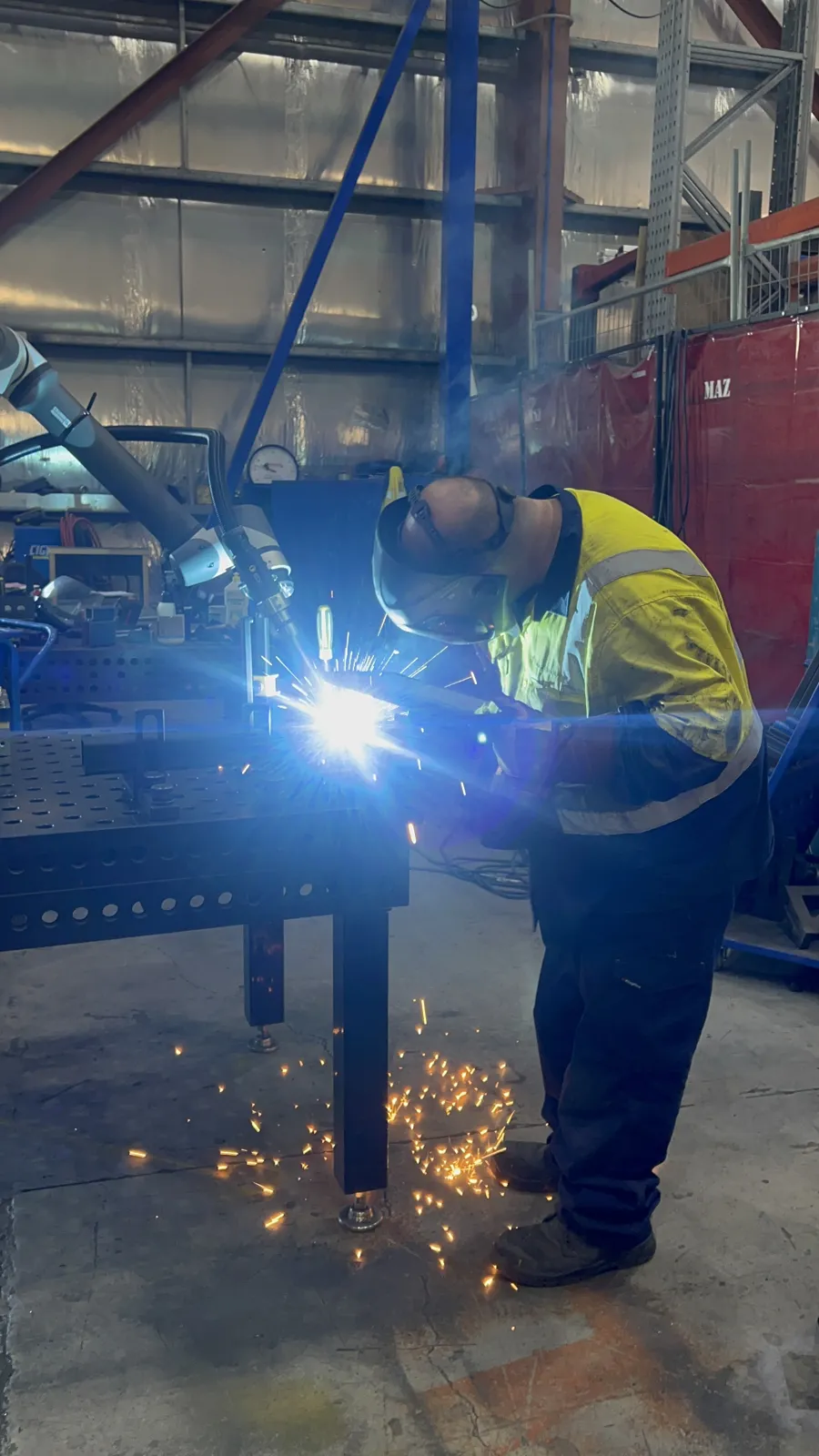
Search for a welding cobot and you'll find complete-looking "cobot welding packages" on overseas marketplaces for US$4,000 to US$9,000. Next to that, a properly engineered cobot welding cell looks expensive. So it's a fair question: is the cheap one just a cheaper version of the same thing?
Usually, no. The difference isn't where the cobot is made. It's whether anyone independent has checked that it's safe to work beside, and whether anyone in Australia stands behind the finished cell.
What the cheap listings actually say
We looked at a sample of low-cost cobot welding listings on a major overseas marketplace in October 2026. Prices ran from about US$3,900 to US$8,900 a set. None of them named a safety certificate. Instead they said things like:
- "Complies with EU standards", with no standard, no certificate and no test body named.
- A "machinery test report" offered as the safety evidence.
- "Adheres to stringent safety certifications", without saying which ones.
One listing even used the same model name as a cobot from a maker that does hold a genuine third-party certificate. That doesn't mean the listed arm is covered. A certificate belongs to the company named on it and the models listed on it. A rebadged or look-alike arm can't borrow it.
Most of these listings also leave out the welder, and none of them include a site risk assessment, installation, training or local support.
Country of origin isn't the question. The certificate is.
Some Chinese cobot makers hold genuine third-party safety certificates from recognised test bodies, with certificate numbers you can look up. Others publish only their own claims. And plenty of the cheapest packages online come from traders who don't name a maker at all.
So don't ask "is it Chinese?" Ask "who certified it, to what standard, and can I check?" A good supplier answers that in one email.
Cobot safety standards in plain English
These are the standards that matter for a welding cobot, and what each one is for:
- ISO 10218-1 covers the robot arm itself. It's the robot maker's job. The 2025 edition adds detailed safety functions and cybersecurity requirements. In Australia, AS 4024.3301 adopts the 2011 edition.
- ISO 10218-2 covers the complete robot system: the torch, fixtures, positioner, guarding and layout. It's the integrator's job. AS 4024.3302 is the Australian adoption.
- ISO/TS 15066 sets the limits for safe contact between a cobot and a person: how much force and pressure is allowed on different parts of the body. The 2025 edition of ISO 10218 brings this guidance into the main standard.
- ISO 13849-1 rates how reliable the safety functions are, such as the protective stop, speed limits and force limits. "PL d, Category 3", the usual rating for a cobot, means a single fault won't stop a safety function working.
One more thing the 2025 standard makes clear: there's no such thing as a "collaborative robot" on its own, only a collaborative application. A cobot arm with a hot welding torch, spatter and sharp parts is only safe to work beside if the whole cell has been designed and assessed that way.
Certificate, test report or CE logo: they're not the same
- A product certificate comes from an accredited certification body such as TÜV SÜD, TÜV Rheinland or SGS. It names the holder, the exact models, the standard and its edition, and it has a number you can check. The certifying body keeps auditing, and can withdraw it.
- A test report shows that one sample passed certain tests on one day. It's useful, but it isn't ongoing certification.
- A CE logo or "complies with" statement is the manufacturer's own declaration. Under EU rules a bare robot arm is "partly completed machinery": it isn't CE-marked as a finished machine at all. The CE mark belongs to the complete cell, applied by whoever integrates it.
You can check a certificate yourself. Search the number in the TÜV SÜD Certificate Finder, TÜV Rheinland Certipedia or the SGS certified products directory, and make sure the company, the model and the standard match what you're being sold.
A certified arm still isn't a safe welding cell
Even a fully certified cobot is only one part of a welding cell. The rest is where most of the risk sits:
- The torch and the arc. A cobot that stops on contact doesn't make a hot torch, arc flash or spatter safe.
- Welding fume. Australia's exposure limit for welding fume is 1 mg/m³, and fume is classed as a cause of cancer. The cell needs extraction designed in.
- Fixtures, positioners and tables. Pinch points, moving parts and part loading all need assessing.
- Electrical safety. Wiring, isolation and emergency stops to Australian Standards, with English labels and manuals.
- A documented risk assessment to ISO 10218-2 and AS 4024, with the safety functions checked on the finished cell.
In Australia, the importer carries the risk
Under the model WHS laws, designers, manufacturers, importers, suppliers and installers of plant each have duties to make sure it's safe, so far as is reasonably practicable. Safe Work Australia's guidance says an importer must get the manufacturer's safety information. If it isn't available, the importer has to arrange the testing themselves. A CE logo doesn't meet that duty for you. Victoria's OHS Act sets similar duties, and WorkSafe Victoria makes the point that safety devices can't be optional extras.
Build a cell from parts you've imported yourself and, legally, you can become its manufacturer. SafeWork SA has issued prohibition notices and switched off imported machinery that didn't meet Australian Standards for wiring, guarding and emergency stops.
What you get from an integrator
When you buy a CoboMate cell from us, the cobot is the smallest part of what you're paying for:
- A certified cobot from a real robotics company. Rainbow Robotics is a South Korean robot maker, with Samsung as its largest shareholder. Rainbow states its RB series meets ISO 10218-1, ISO/TS 15066 and ISO 13849-1 (PL d, Category 3), with CE and Korean KCs approval through TÜV SÜD and North American certification too.
- Proof before you pay. We weld your own part on a cobot in our workshop, free, and give you the video, cycle time and a fixed quote.
- A cell designed around your parts. Welder, torch, tables, positioners, fixtures, fume extraction and safety, specified by welding and mechanical engineers.
- Risk assessment and compliance. The whole cell is assessed and documented, not just the arm.
- Installed and trained on your site. Anywhere in Australia or New Zealand, typically 4–6 weeks from order for hardware and training.
- One local team accountable for it all. Programming help, new parts, spares and repairs from the engineers who built your system, not a trader overseas.
When something stops working on a Friday afternoon, that last point is worth more than the price difference.
10 questions to ask before you buy any cobot welder
- What's the certificate number for this exact arm and controller, and which body issued it?
- Is that body accredited to certify products (for example under ISO/IEC 17065, or an OSHA-recognised test lab)?
- Which standards and editions does it cover: ISO 10218-1 (2011 or 2025) and ISO 13849-1?
- Which safety functions are certified, and at what Performance Level and Category?
- Is it a certificate, a test report or a self-declaration? Can I see the full document and look it up?
- Is the company on the certificate the brand I'm buying, and does it cover this model?
- Who is responsible for the complete welding cell, and is there a risk assessment to ISO 10218-2 and AS 4024?
- Is the electrical work to AS/NZS 3000, with Australian-standard emergency stops and English documentation?
- How is welding fume controlled, and how will you show it's under the limit?
- Who in Australia supplies spares, repairs and training, and how fast?
If a supplier can't answer the first question, you don't need to ask the other nine.
The bottom line
A cheap cobot welder can look like a bargain on a screen. But an arm without a checkable certificate, without a risk-assessed cell around it and without anyone local to stand behind it isn't a cheaper version of a cobot welding system. It's a different, riskier product. Ask for the certificate number, and buy the cell, not just the arm.
Want to see a certified cobot weld your own part? Book a free proof of concept, or see what changes the price of a complete system.
Sources
- ISO 10218-1:2025, Robotics: Safety requirements, Part 1
- A3: Updated ISO 10218 FAQ
- Safe Work Australia: Guide to importing and supplying safe plant
- Safe Work Australia: Plant WHS duties
- WorkSafe Victoria: Importing and supplying plant
- SafeWork SA: Imported plant not compliant with Australian Standards
- NSW Centre for WHS: Guidelines for safe collaborative robot design and implementation
- EU-OSHA: Machinery Regulation (EU) 2023/1230
- Rainbow Robotics: RB series
- Welding fume limits in Australia